The world your AI acts in.
Enterprise AI stalls on integration, not on model quality — and no model is coming to fix that. None will ever ship knowing your entities, your systems or your permissions, and a bag of MCP tools only leaves it improvising every join. The piece nobody has built is the world itself: typed, governed, queryable, and yours.
Embabel Worlds builds it, from the systems you already run. It stands up in days, it belongs to you, it runs on your own machine — and you can install it today.
curl -fsSL https://worlds.embabel.com/install.sh | EMBABEL_MODE=worlds sh $env:EMBABEL_MODE = 'worlds'; irm https://worlds.embabel.com/install.ps1 | iex
No account, no waitlist, no sales call. Docker and your own model provider key —
it runs on your machine and nothing routes through us.
On integration as the cause rather than model quality: MIT Project NANDA, State of AI in Business (2025).
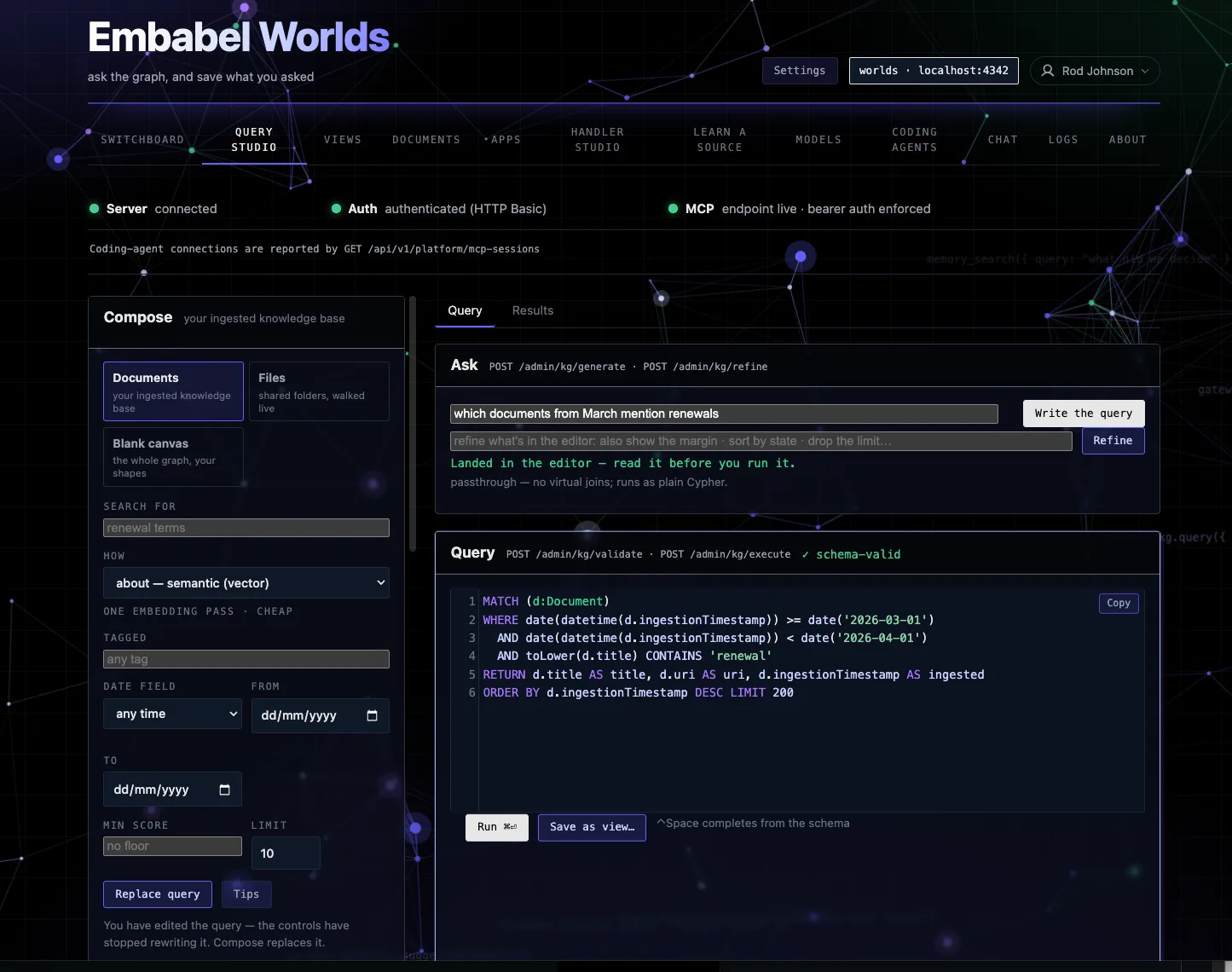
Answers, watches, acts
Three things, from the first afternoon — not after a quarter of integration work. It links what you already own, any source and any format, into one continuously updated graph with per-user access control.
It answers
Any question, across any system, for anyone — including your agents. The joins your dashboards cannot make, because no single system holds both halves. With sources, so an answer can be checked rather than believed.
It watches
Any change, anywhere, surfaced the moment it happens. A standing question beats a dashboard nobody remembers to open — the drift, the recall, the clause that moved, arriving before it costs you.
It acts
Multi-step work run end to end, with approval gates exactly where you want them. The answer stops being a report somebody has to action.
The shape of question that has no home today
Each of these needs two systems that have never been joined. Today somebody exports a spreadsheet and does it by hand, monthly. Here it is one question, and you can leave it running.
- Which customers renew inside 30 days and have an open support ticket?
- Which signed contracts have a liability clause that drifted from the template?
- Which parts in this recall are still in inventory, and who bought them?
- Which of last quarter’s deals stalled at the same step, and what did they have in common?
- The first afternoon: point it at a folder and one system you already run, and ask something that spans them. PDFs, decks and spreadsheets go in as they are — there is no ingestion project.
- Day two: the questions worth asking twice become saved views. The ones worth asking continuously become alerts that reach you when the answer changes.
- Day three: it is already an MCP server, so the tools your team uses get the whole world instead of another single-system connector.
Model, harness, world
Two of the three have had all the money. Models are converging and rentable. The harness around them is commoditizing fast. The third — the environment the AI acts in, typed and governed and yours — is the one nobody has built, and the one where the value accumulates.
The model
Fungible intelligence, converging in a narrow band. However good it gets, no model will ever ship knowing your entities, your systems or your permissions.
The harness
Context management, subagents, recovery loops. Real machinery, and increasingly a commodity — everyone has one.
The world
What the agent acts in: typed, governed, queryable, and owned by you. A bag of MCP tools is not this — it leaves the model improvising every join.
AI coding worked because code came with a world already: compilers, tests, a sandbox to be wrong in. Your business does not have one. Embabel builds it from what you already own.
One question, across systems that were never joined
Your graph holds what you own. The rest — a CRM contact, a support ticket, a valuation, a public record — lives in someone else’s system. Virtual Cypher lets a query traverse into it as though it were already there: the engine fetches the far side on demand, materializes it for the life of the query, and rolls it back. Nothing is mirrored, so nothing goes stale, and no answer is older than the question.
MATCH (p:Person {name:'Ada Lovelace'})-[:HAS_HUBSPOT_CONTACT]->(c:HubSpotContact) RETURN c.company A capability is a repository
You extend a world by installing a realm: a folder of declarative YAML in git. Drop one in and the runtime wires up what it declares — types, actions, goals, APIs, MCP servers, scheduled work, saved queries, whole dashboards. Nothing to compile, and nothing you cannot read before you trust it.
Declarative
YAML, plus TypeScript handlers where real logic is needed. No JVM bytecode and no native binaries — a realm is auditable by reading it.
Composable
Install several. They share one graph, and the spec says exactly what happens when two realms describe the same entity.
Yours
Fork one, fix it, point the runtime at your copy. Realms resolve from any GitHub org or user you configure — starting with your own.
Stand one up
One command. It checks Docker, unpacks the runtime, walks you through your account
and your model provider key, and ends by opening the console at
localhost:4343. It installs nothing globally, needs no root, and binds
everything to your loopback interface rather than the network.
curl -fsSL https://worlds.embabel.com/install.sh | EMBABEL_MODE=worlds sh $env:EMBABEL_MODE = 'worlds'; irm https://worlds.embabel.com/install.ps1 | iex - Then: drop a folder of documents on the console. It converts and indexes them as they are.
- Then: install a realm —
realm-github,realm-hubspot,realm-stripe— and it can reach that system live, without mirroring it. - Then: ask the first question that needs both. That is the one that has never had an answer.
Piping a script into a shell is a thing you should be suspicious of — so read it first: install.sh for Linux/macOS, install.ps1 for Windows. Both are deliberately short, and both are the same files the public repository serves.
| What you need | Why, and what it costs |
|---|---|
| Docker Desktop | The runtime is containers. Free, and a sizeable first download. Model Runner must be enabled — embeddings run locally, on your hardware. |
| A model provider key | Your own key, from Anthropic or OpenAI. You pay them directly for what you use; nothing routes through Embabel. |
| Disk and memory | Several gigabytes for images and the graph. It is a real system running on your own machine, and it is honest about that. |